eGPUs Are Back: Does Thunderbolt 5 Make External GPUs Worth Buying Again?
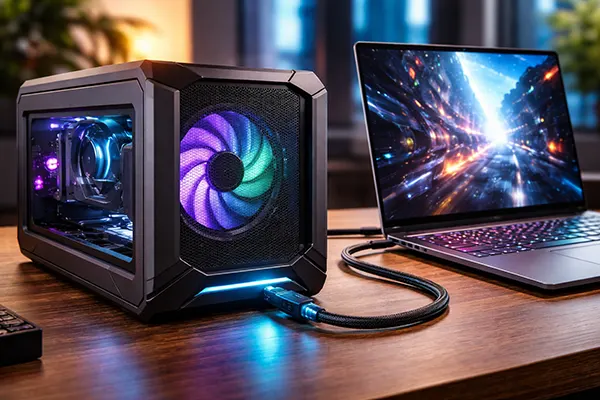
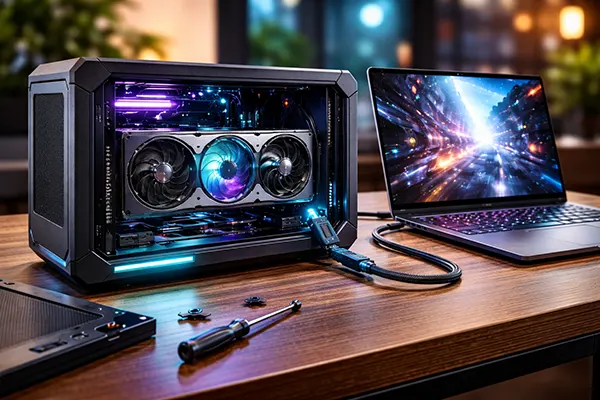
The idea of connecting a desktop-grade graphics card to a laptop has always sounded appealing, yet for years it remained a compromise rather than a genuine alternative to a full PC. Bandwidth limitations, unstable drivers and questionable price-to-performance ratios held eGPUs back. With Thunderbolt 5 entering the market in 2025–2026, the conversation has changed. The new standard promises dramatically higher data throughput, and that alone forces a reassessment: is an external GPU finally a sensible investment rather than a niche experiment?
Why eGPUs Struggled Before Thunderbolt 5
Earlier generations of external GPUs were built around Thunderbolt 3 and later Thunderbolt 4, both offering up to 40 Gbps bandwidth. While this was impressive for general peripherals, it proved restrictive for modern GPUs that rely on high-speed PCIe connections. In practice, users often experienced a performance drop of 20–40% compared to the same GPU installed in a desktop.
Another issue was latency. Even when raw bandwidth seemed sufficient, the additional overhead introduced by external connections resulted in lower frame rates and occasional stuttering, particularly in CPU-heavy or competitive titles. For professional workloads such as 3D rendering or video editing, this inconsistency made eGPUs unreliable.
Cost also played a significant role. Users needed to purchase not only a graphics card but also an enclosure with its own power supply and cooling system. When combined, the total expense often approached that of a mid-range desktop PC, making the value proposition difficult to justify.
Real-World Limitations That Affected Adoption
Compatibility was far from seamless. Many laptops technically supported Thunderbolt connections but lacked proper firmware optimisation for eGPU use. This led to inconsistent plug-and-play experiences, especially on Windows systems where driver conflicts were common.
Thermal management in enclosures was another weak point. Compact designs struggled to maintain stable temperatures for high-end GPUs, forcing users to accept either louder cooling solutions or reduced performance due to throttling.
Finally, the target audience itself remained narrow. Casual users had little need for external GPUs, while professionals and gamers often preferred the reliability and upgrade flexibility of traditional desktops. As a result, eGPUs stayed on the fringes of the market.
What Thunderbolt 5 Changes in 2026
Thunderbolt 5 introduces a significant leap in bandwidth, reaching up to 80 Gbps bi-directional and up to 120 Gbps in certain display-heavy scenarios. This effectively doubles the capacity of previous standards and reduces one of the main bottlenecks that limited eGPU performance.
Equally important is the move to PCIe Gen 4 tunnelling. This allows external GPUs to communicate with the system more efficiently, narrowing the gap between external and internal configurations. Early tests in 2026 show performance losses dropping to around 10–15% in many workloads, which is a notable improvement.
Manufacturers have also refined software integration. Modern laptops designed for Thunderbolt 5 increasingly include native support for external graphics, reducing setup complexity. In many cases, connecting an eGPU is now closer to a true plug-and-play experience than ever before.
Performance Gains and Practical Impact
For gaming, the higher bandwidth translates into more stable frame rates and better utilisation of high-end GPUs. While a slight performance gap still exists compared to desktop installations, it is no longer large enough to be a deal-breaker for most users.
Creative professionals benefit even more. Tasks such as video encoding, 3D modelling and AI workloads scale well with GPU power, and the improved connection speeds allow external setups to deliver consistent results without major bottlenecks.
Another advantage lies in display support. Thunderbolt 5 enables higher refresh rates and multiple high-resolution monitors without compromising GPU performance, making eGPU setups more viable for multi-screen workflows.
Is an eGPU a Logical Purchase Today?
In 2026, the answer depends heavily on the user’s priorities. For laptop owners who need portability but occasionally require desktop-level graphics power, an eGPU now makes far more sense than it did a few years ago. The performance trade-offs have been reduced to a level that many users will consider acceptable.
However, cost remains a critical factor. Even with improved technology, the combined price of a high-quality enclosure and a modern GPU is substantial. For users starting from scratch, building or buying a desktop system still offers better value in most cases.
There is also the question of longevity. Thunderbolt 5 is still relatively new, and the ecosystem of compatible devices is growing but not yet universal. Buyers should ensure that both their current and future hardware will support the standard to avoid compatibility issues.
Who Benefits Most from eGPU Setups
Mobile professionals are among the primary beneficiaries. Designers, video editors and developers who travel frequently can rely on a lightweight laptop for daily work and connect to an eGPU at home or in the office for demanding tasks.
Gamers who prefer a single device may also find value in this approach. A laptop paired with an external GPU can serve as both a portable machine and a capable gaming system without maintaining two separate setups.
On the other hand, users who prioritise maximum performance, upgrade flexibility and cost efficiency will still find traditional desktops more practical. eGPUs have improved significantly, but they are not a universal replacement for dedicated systems.