
DisplayPort 2.1b Explained: When UHBR20 Matters for 4K, 5K and 8K Setups
Display interfaces have changed rapidly during the last few hardware generations. Modern GPUs are capable of pushing extremely high refresh rates at 4K and beyond, while professional displays are moving towards 5K, 6K and even 8K panels. In this environment the video interface becomes more than a simple connector — it defines whether a system can actually deliver the image quality the hardware promises. DisplayPort 2.1b, combined with UHBR20 signalling and new certified cables, is one of the most important updates in this space. By 2026 the standard has begun to move from specification sheets into real desktop builds, and understanding when it actually matters helps avoid unnecessary upgrades while ensuring stability for demanding setups.
What DisplayPort 2.1b Actually Changes Compared to Earlier Versions
DisplayPort 2.1b is an evolution of the DisplayPort 2.1 standard introduced by VESA to support much higher bandwidth and more robust cabling for modern monitors. Earlier DisplayPort versions, including 1.4a, relied on HBR3 signalling with a maximum bandwidth of 32.4 Gbit/s. While this was sufficient for 4K displays at moderate refresh rates, it quickly becomes limiting when pushing high-refresh 4K panels or multi-monitor professional environments.
The new specification introduces Ultra-High Bit Rate (UHBR) signalling modes. The most relevant of these is UHBR20, which delivers up to 80 Gbit/s of raw bandwidth across the four DisplayPort lanes. This dramatically increases the amount of data that can be transmitted without relying heavily on compression technologies such as Display Stream Compression (DSC).
For users running modern graphics cards and high-resolution displays, this bandwidth increase means support for scenarios that previously required compromises. Examples include 4K monitors at refresh rates above 240 Hz, 5K displays at high refresh rates without aggressive compression, and certain early 8K display configurations.
How UHBR20 Enables New Display Configurations
UHBR20 becomes particularly important in setups where both resolution and refresh rate are pushed simultaneously. A common example in 2026 is the 4K 240 Hz gaming monitor. These displays generate an enormous data stream, and older DisplayPort standards either require compression or reduce colour depth to maintain stability.
Professional environments also benefit from the additional bandwidth. Content creators working with 5K or 6K displays — especially those used in video editing or colour-critical work — require high bit depth and consistent signal integrity. UHBR20 allows these displays to operate with fewer compromises, maintaining full colour information and smoother refresh behaviour.
Even though compression technologies like DSC remain widely used, UHBR20 reduces dependence on them. This can simplify compatibility between GPUs, monitors and cables, which becomes increasingly important as workstation and gaming setups grow more complex.
DisplayPort 2.1b vs USB-C, USB4 and Thunderbolt 5
Modern display connections are no longer limited to traditional DisplayPort cables. Many laptops and compact desktops now transmit video through USB-C connectors using DisplayPort Alt Mode. At the same time, USB4 and Thunderbolt 5 introduce their own high-bandwidth data paths that can carry display signals alongside storage and networking traffic.
DisplayPort 2.1b is designed to integrate with these interfaces rather than compete with them. In USB-C environments the DisplayPort signal is simply encapsulated within the USB-C link. This means a USB-C connection may still rely on DisplayPort standards to determine the maximum display resolution and refresh rate.
Thunderbolt 5 represents another layer in the ecosystem. It offers extremely high bidirectional bandwidth, which can carry DisplayPort streams alongside PCIe traffic. However, the display capability itself still depends on the DisplayPort protocol used within the Thunderbolt connection.
When DisplayPort Still Remains the Preferred Option
Despite the flexibility of USB-C and Thunderbolt connections, a dedicated DisplayPort cable often remains the most stable solution for desktop systems. It avoids bandwidth sharing with storage devices or network adapters and ensures the entire link is dedicated to video transmission.
This becomes particularly important in high-refresh gaming setups where even small signal inconsistencies can cause display flickering or link renegotiation. Direct DisplayPort connections provide predictable behaviour and minimise compatibility issues.
Professional multi-monitor environments also benefit from this stability. Workstations running several high-resolution displays simultaneously tend to rely on dedicated DisplayPort outputs rather than shared USB-C hubs, as this reduces signal contention and simplifies troubleshooting.
Why Cable Certification Became Critical in 2026
One of the most practical changes around DisplayPort 2.1b is the increased attention given to cable certification. As bandwidth increases, signal integrity becomes significantly harder to maintain across longer distances. Even small imperfections in shielding or conductor quality can introduce instability.
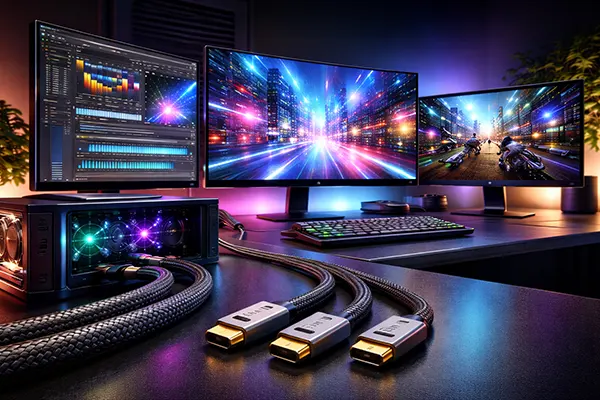
To address this issue, VESA introduced stricter certification categories, including DP80 and DP80LL cables. These cables are specifically designed to support UHBR20 signalling reliably, even in longer cable runs used in desk setups or studio environments.
By 2026 many monitor issues that appear to be GPU or driver problems are actually caused by inadequate cables. Systems capable of UHBR20 speeds may silently downgrade to lower signalling modes if the cable cannot maintain the required data rate.
How to Choose the Right Cable for High-Bandwidth Displays
When building a modern workstation or gaming system, the cable should be treated as part of the display hardware rather than an accessory. Certified DP80 cables ensure that UHBR20 links operate at their full rated bandwidth without unexpected signal drops.
Cable length also matters more than many users realise. While short cables generally perform well, longer connections may require the newer DP80LL variants designed for extended distance. Using uncertified cables in these scenarios often results in intermittent display detection or reduced refresh rates.
As displays continue to evolve beyond 4K and refresh rates increase, stable cabling becomes just as important as the GPU or monitor itself. For systems built around modern graphics cards and high-end displays, choosing certified DisplayPort 2.1b cables is a simple step that prevents many real-world compatibility issues.