LPDDR5X vs DDR5 in Desktop Computers: Prospects for Energy-Efficient Memory
Modern desktop systems continue to evolve toward higher performance and lower energy consumption, and memory standards play a decisive role in this shift. While DDR5 has already established itself as the mainstream choice for consumer PCs, LPDDR5X is rapidly developing as an energy-efficient alternative traditionally used in laptops and mobile devices. By 2025, interest in bringing LPDDR5X to desktops has grown due to improvements in bandwidth, latency behaviour, and power management. However, the transition is not straightforward. This article explores the technical differences, real-world performance implications, and the realistic potential of LPDDR5X becoming available in desktop motherboards.
Technical Characteristics of LPDDR5X and DDR5
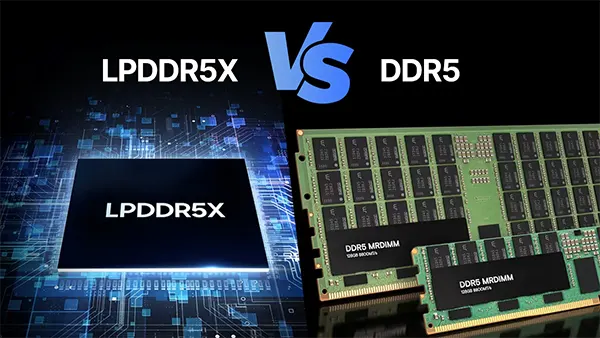
DDR5 remains the standard memory format for most desktop configurations, offering high frequencies, improved stability, and broad compatibility. It is designed to work with removable DIMMs, enabling upgrades and advanced cooling solutions. Manufacturers continue to push DDR5 kits to 8000 MT/s and beyond, which keeps this technology competitive for gaming, workstation tasks, and overclocking communities. Its design philosophy prioritises capacity, upgradability, and power delivery suited for full-scale PC systems.
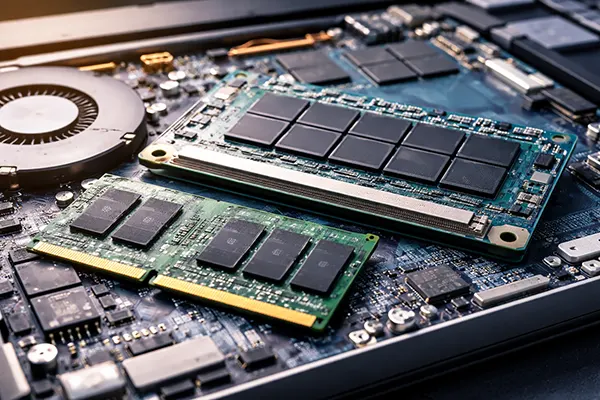
LPDDR5X follows a different approach. It is soldered directly onto the motherboard and optimised for ultra-low voltage operation, typically running at 0.5–0.6 V compared to DDR5’s higher demands. Despite the energy-focused design, LPDDR5X can achieve remarkable transfer rates of up to 9600 MT/s, making it an impressive alternative in terms of raw bandwidth. The technology integrates advanced power-saving modes originally tailored for laptops, which significantly reduce idle and active power consumption in compact systems.
Compatibility remains the major barrier for LPDDR5X in desktops. The physical architecture of soldered memory requires a tightly integrated motherboard design. Traditional ATX boards cannot simply accommodate LPDDR5X without a fundamental redesign, and only certain compact systems, such as integrated mini-PCs, have experimented with this approach. As of 2025, no major desktop motherboard manufacturer offers LPDDR5X-based boards for mass-market home PCs.
Bandwidth, Latency, and Performance Impact
Bandwidth figures often cause misunderstanding when comparing LPDDR5X with DDR5. Although LPDDR5X supports extremely high data rates, real-world desktop workloads depend heavily on memory latency. LPDDR5X typically exhibits higher latency than DDR5 DIMMs due to the nature of its architecture. This means that certain workloads—such as gaming, real-time rendering, or tasks requiring rapid memory access—tend to benefit more from DDR5’s lower latency, even if its bandwidth is smaller on paper.
In contrast, workloads that rely on streaming large datasets, including AI inference, content creation, and scientific computing, may perform competitively on LPDDR5X. Its energy efficiency also makes it appealing for always-on desktops or silent, low-power workstations. Balanced systems built around efficiency-focused desktop CPUs could theoretically gain benefits from LPDDR5X integration if motherboard support becomes available in the future.
Thermal characteristics further differentiate the two standards. LPDDR5X produces significantly less heat than DDR5, allowing tighter component spacing and potentially quieter systems. However, soldered design limits thermal management options and makes replacement impossible. For high-end computing where sustained heavy workloads are common, DDR5’s flexibility and cooling potential remain advantageous.
Adoption Potential in Desktop Motherboards
Despite the technical advantages of LPDDR5X, desktop adoption requires alignment from motherboard vendors, CPU manufacturers, and system integrators. Desktop CPUs from AMD and Intel are currently engineered around DDR5 DIMMs. To support LPDDR5X, they would need new memory controllers built specifically for soldered low-power memory. Such a fundamental architectural shift is unlikely to occur rapidly, especially given DDR5’s ongoing maturity and rising maximum capacities.
Some compact form factor systems have already experimented with LPDDR5X. Mini-PCs based on mobile processors frequently include LPDDR5X for silent operation and low power usage. This demonstrates that the technology performs reliably in small desktop-style systems, although these are closer to mobile-derived platforms rather than traditional desktop hardware.
Industry trends suggest that LPDDR5X desktop motherboards may appear only in specialised segments, such as energy-efficient office units, fanless workstations, or AI-optimised compact devices. For mainstream gaming or professional desktops in 2025, DDR5 remains the primary standard due to its flexibility, availability, and ecosystem support.
Manufacturing Considerations and Market Constraints
Motherboard manufacturers must invest heavily to develop LPDDR5X-compatible designs. Since the memory modules are soldered, production lines need stricter quality control procedures and advanced PCB layering standards. This increases both cost and production complexity, which makes LPDDR5X less attractive for budget or enthusiast-grade desktop boards.
Another obstacle is consumer preference. Many desktop users value the ability to upgrade their memory, something LPDDR5X cannot offer. The absence of replaceable modules contradicts one of the core features of standard desktop systems. Until market demand shifts towards integrated memory solutions, LPDDR5X will likely remain confined to specific use cases.
Pricing also plays a role. While LPDDR5X is cost-effective for laptops produced in large volumes, implementing it in lower-volume desktop motherboards reduces economic efficiency. DDR5 continues to drop in price year by year, making it a more favourable option for both manufacturers and consumers.

Energy Efficiency and Real-World Desktop Scenarios
Energy efficiency is where LPDDR5X shows clear superiority. It consumes significantly less power under both idle and active conditions. This is critical for devices operating continuously or in environments where heat output must be kept to a minimum. In desktops designed for minimal noise or passive cooling, LPDDR5X would offer measurable benefits.
DDR5 remains more suitable for high-performance systems, yet efficiency improvements continue through technologies such as on-die ECC, advanced PMICs, and refined JEDEC profiles. Modern DDR5 operates more efficiently than earlier DDR4 generations, narrowing the gap to LPDDR5X in some scenarios. However, LPDDR5X’s underlying design still provides a consistent advantage in low-power operation.
In 2025, the most realistic scenario for LPDDR5X in desktops is the rise of hybrid categories—systems using mobile-class processors housed in desktop-style enclosures. These devices already adopt LPDDR memory for efficiency and compactness. If such systems continue gaining popularity, LPDDR5X could organically expand its presence across the desktop landscape.
Future Prospects and Technological Outlook
Looking ahead, both memory standards will continue to evolve. DDR5 will push frequencies and capacities higher, while LPDDR5X—and its successors—will refine energy management and raise bandwidth ceilings. The divergence in design philosophy means neither standard will replace the other entirely. Instead, each will serve different roles depending on system requirements.
For traditional desktop PCs, DDR5 will retain dominance until hardware ecosystems shift significantly. CPU and motherboard manufacturers have no immediate plans to adopt LPDDR5X across mainstream desktop line-ups in 2025. Their focus remains on enhancing DDR5 compatibility, stability, and performance.
Nevertheless, LPDDR5X’s relevance will grow in specialised desktops built for silence, low heat output, or compact form factors. With increasing interest in energy-efficient computing, the technology could gradually gain traction, particularly in professional sectors seeking reduced power consumption without compromising bandwidth.